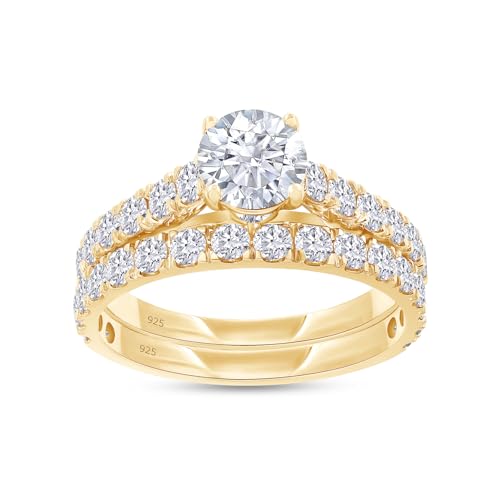
Engagement Rings with Matching Wedding Bands
"Two rings, one seamless story. How to choose a bridal set that fits your hand, your style, and your everyday life."
An engagement ring is worn alone for months, sometimes years, before a wedding band joins it. That moment when the second ring slides on changes the way the whole stack looks, feels, and wears. A band that sits crooked, scratches the prongs, or clashes with the setting turns a meaningful symbol into a daily irritation.
This is why so many couples now shop for engagement rings with matching wedding bands from the start. A coordinated pair removes the risk of a poor fit and creates a unified look that reads as intentional rather than accidental.
Below, we walk through how matching sets are constructed, what to check before you commit, and how to choose a pairing that will still look right decades from now.
Why Matching Sets Are Worth Considering
A matching set solves three problems at once: fit, style, and timing.
Fit: The band is designed to sit flush against the engagement ring, so there is no gap, no wobble, and no metal-on-metal grinding.
Style: Shared design language—the same milgrain detail, the same diamond accents, the same curve—makes the stack look deliberate.
Timing: You choose both rings while the design is fresh in your mind, rather than hunting for a matching band years later when the collection may have been discontinued.
The trade-off is flexibility. A set locks you into one designer's vision. If you would rather build something personal, starting with a custom engagement ring gives you full control and lets you design the band to complement it later.
How a Bridal Set Actually Works
A bridal set is simply an engagement ring paired with a wedding band designed to be worn together. Within that simple definition, there are several configurations worth understanding.
Two-Piece Bridal Sets
The classic setup: one engagement ring and one women's wedding band. This is the most common option and the one most shoppers mean when they search for matching sets. If you also want a ring for your partner, you would add a men's band separately.
Three-Piece Sets
These include the engagement ring plus two bands—often one contoured band for her and one straight band for him. This is the most efficient route for couples who want a coordinated look without shopping twice.
Stackable and Add-On Sets
Some sets are built around a slim engagement ring with two thin bands that can be worn one on each side, or stacked together on one side. These work well for couples who like an evolving stack and may add an anniversary band later.
Flush Bands vs. Contour Bands
This is the single most important technical detail when pairing rings, and it is where most mismatched purchases go wrong.
Flush-Fit Bands
A straight band that sits directly against the engagement ring with no gap. This works only when the engagement ring's center stone sits high enough, or the shank is narrow enough, that the band does not collide with the setting.
Best for: solitaire settings with a raised head, low-profile bezels, and simple shanks.
Contour Bands
Also called curved, chevron, or shaped bands. The band bends around the center stone so the two rings interlock. This is the standard solution for halo settings, three-stone rings, and any ring with a wide or low-set center.
Best for: halo rings, cluster settings, and anything with a prominent center stone.
💡 Try before you buy: If you are pairing a band with a ring you already own, place the two rings together on a flat surface and check for gaps. A visible gap is not just cosmetic—it lets the rings rub against each other, which wears down prongs and shanks over time.
Matching Metals & Finish
Metal choice affects both the look of the stack and how the rings wear against each other. For a deeper look at individual metals, see our guide to gold wedding bands and gold and diamond wedding ring sets.
Yellow Gold
Warm, classic, and highly scratch-resistant in higher karats. A yellow gold engagement ring with a matching yellow gold band is one of the most durable pairings because both rings share the same hardness and wear pattern. Popular for traditional and vintage-inspired styles.
White Gold and Platinum
White gold is rhodium-plated for a bright finish, while platinum is naturally white and denser. The important detail is plating: white gold bands need re-plating periodically, and if only one ring in the stack is re-plated, the two may drift to slightly different shades over time. Platinum pairs best with platinum, and white gold with white gold.
Rose Gold
Increasingly popular for bridal sets because the warm tone flatters most skin tones and pairs beautifully with both white and yellow accents. Rose gold is a copper alloy, so it is slightly softer than white gold—worth knowing if you are hard on your hands.
Mixed Metals
A two-tone stack, such as a white gold engagement ring with a yellow gold band, is a legitimate design choice. If you go this route, keep the two metals close in hardness and have a jeweler inspect the contact points every year or two.
Stone Shapes & Band Pairings
Center stone shape heavily influences which band style looks right. Here is how the most popular cuts pair up.
- Round brilliant: The most versatile shape. Almost any band works, but a round brilliant cut diamond engagement ring pairs especially well with a thin pavé band or a plain high-polish band that lets the stone dominate.
- Oval: Elongated and flattering. A band with a gentle curve or a oval diamond ring with diamond band creates a soft, continuous line. Avoid heavy straight bands that visually cut the oval in half.
- Emerald and radiant cuts: Step-cut stones have clean, architectural lines. A emerald cut diamond band or a emerald cut wedding ring echoes those lines and looks crisp and modern.
- Radiant: Combines a rectangular outline with brilliant faceting. See our notes on radiant cut engagement rings for pairing guidance.
- Sapphire centers: Colored stones change the styling rules slightly. A sapphire engagement ring or blue sapphire engagement ring often looks best with a band that repeats the accent color rather than competing with it.
If you want the widest range of band options, a natural diamond engagement ring in a classic shape gives you the most flexibility. If you prefer a cooler, more contemporary look, explore diamond with black diamond engagement rings.
His and Hers Matching Sets
Coordinated sets for both partners have moved from novelty to mainstream. The idea is not that the rings look identical—it is that they share a visual language, such as the same metal, the same finish, or the same width proportion.
For a traditional look, consider wedding ring sets his and hers or bridal ring sets his and hers. For a modern approach, a white gold wedding ring for him paired with a white gold engagement and band set for her creates a clean, unified look without being literal.
Men's rings have expanded well beyond plain bands. If your partner wants something with more presence, look at wedding rings with diamonds for men, gold wedding bands for men with diamonds, or gold diamond wedding bands for men.
Coordinate, don't clone: The most successful his-and-hers sets share one or two design elements—metal, finish, or width ratio—rather than matching exactly. Identical rings in different sizes often look unbalanced because men's bands are typically wider.
Shopping & Sizing Tips
Size the Stack, Not Just the Ring
A wedding band worn on top of an engagement ring needs slightly more room than the engagement ring alone. The combined width of two bands can push a snug ring into uncomfortable territory. Get sized while wearing both rings if possible, and consider a quarter size up for the band.
Check the Band Width Ratio
A 2mm band next to a 2.5mm engagement ring shank looks balanced. A 1.5mm band next to a 3mm shank looks thin and can appear to be sinking into the wider ring. Keep the widths within roughly a millimeter of each other unless you are deliberately going for a delicate contrast.
Consider Daily Wear
Pavé and channel-set bands catch on clothing more than plain bands. If you work with your hands, a plain or milgrain band may serve you better day to day, even if the pavé version photographs more dramatically. Some couples buy a plain band for daily wear and a diamond band for occasions.
Ask About Resizing Policy
Bands with full-eternity diamond settings usually cannot be resized, or can only be resized slightly. If there is any chance your finger size will change, favor a half-eternity or a band with a plain sizing area at the back. See our notes on eternity band rings and eternity band diamond rings for the trade-offs.
Protect the Purchase
Add the rings to your homeowner's or renter's insurance, or take out a standalone jewelry policy. Keep the appraisal and receipt in a safe place—most policies require them for a claim.
💡 One more thing: Confirm which finger you will wear the stack on and whether it will be your dominant hand. Traditional etiquette places the engagement ring and band on the ring finger of the left hand, but some cultures and professions differ. Our guide to what finger your wedding band goes on covers the variations.