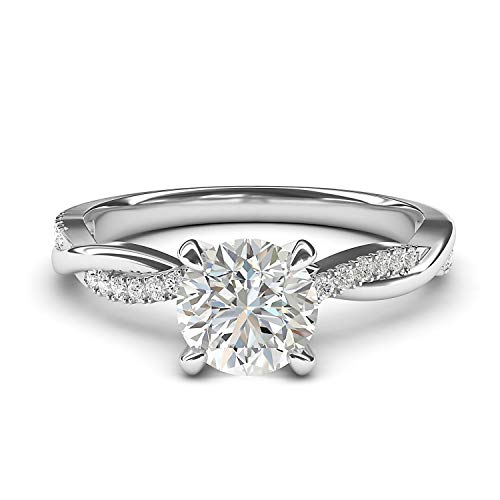
The Complete Guide to Round Brilliant Cut Diamond Engagement Rings
Discover why the round brilliant is the timeless icon of brilliance. Learn the 4Cs, smart budgeting tips, and how to buy a ring that will dazzle for a lifetime.
Few symbols of love are as universally cherished as the round brilliant cut diamond engagement ring. With 58 precisely angled facets designed to maximize light return, this classic shape offers more fire and scintillation than any other diamond cut. Whether you're starting your search or ready to say "yes," understanding the nuances of the round brilliant will empower you to make a confident, informed purchase — and potentially save thousands without sacrificing beauty.
💎 Why the round brilliant cut reigns supreme: Its symmetrical circle and exceptional brilliance make it incredibly forgiving to minor color or clarity inclusions. This means you can prioritize size (carat weight) while still enjoying a breathtaking sparkle that outperforms any other shape.
The 4Cs of a Round Brilliant Cut Diamond
To choose the perfect ring, you must master the 4Cs: Cut, Color, Clarity, and Carat Weight. For round brilliants, the Cut is by far the most important factor. A poorly cut diamond, even with perfect color and clarity, will look dull. Conversely, an Excellent or Ideal cut can make a lower-color diamond radiate.
✂️ Cut Quality (Priority #1)
Only round brilliants receive a cut grade from labs like GIA. Aim for Excellent or Ideal. This guarantees optimal proportions for maximum brilliance. Avoid “Very Good” or lower — light leakage will reduce sparkle.
🎨 Color (Budget Smart)
Round brilliants reflect so much light that they mask body color exceptionally well. You can safely go down to H or I color without noticing any warmth. D-F are "colorless" but overkill for most budgets. Sweet spot: G-H.
🔍 Clarity (Eye-Clean)
Because round brilliants hide inclusions well, choose SI1 or even eye-clean SI2. VS1 or higher is unnecessary unless you have a microscope. Always ask for "eye-clean" — no visible flaws at arm's length.
Top pick: SI1 → saves 20-30% vs VS2 with no visible difference.
⚖️ Carat Weight (Size Matters)
Set your budget first, then maximize carat. The difference between 0.9ct and 1.0ct is often unnoticeable but the price jumps significantly. Consider 0.9ct or 1.2ct to get more size per dollar.
How to Build a Smart Budget for Your Round Brilliant
Typical engagement ring budgets in the US range from $3,000 to $12,000+, but you can get a stunning round brilliant for under $4,000 if you prioritize cut and choose smart compromises on color/clarity. Here's a realistic breakdown based on current market prices (June 2026):
📊 Estimated retail prices for round brilliant cut diamonds (loose, GIA certified, Excellent cut):
- 0.70 ct – H/SI1 : $1,800 – $2,400
- 0.90 ct – G/SI1 : $3,200 – $4,000
- 1.00 ct – H/SI1 : $4,500 – $6,000
- 1.20 ct – I/VS2 : $6,500 – $8,500
- 1.50 ct – G/VS2 : $11,000 – $15,000+
💡 Pro tip: Lab-grown diamonds cost 70-80% less than natural, identical in optical properties and hardness. A 1.5 ct lab round brilliant with Ideal cut can be found for under $2,500.
Where to allocate your budget: Spend 70-75% of your total ring budget on the diamond itself, and 25-30% on the setting (platinum, 14k/18k gold, or pavé band). For a ring that looks more expensive, choose a wedding ring setting with a hidden halo or delicate side stones.
Best Engagement Ring Settings for Round Brilliant Diamonds
The setting you choose influences both the ring's security and its visual impact. Because the round brilliant is so versatile, almost any setting works beautifully. These are the top choices among our readers:
- Solitaire (Prong setting): Timeless, classic, lets the diamond shine. Six-prong settings are more secure than four-prong.
- Halo setting: A circle of small diamonds surrounds the center stone, adding extra sparkle and making the center appear 0.3–0.5 carat larger.
- Pavé band: Small diamonds embedded along the band create a continuous glitter – perfect for those who love maximal sparkle.
- Three-stone (trilogy): Represents past, present, future; great for adding side diamonds that complement the round brilliant.
When shopping, pay attention to ring width (1.8mm–2.2mm is ideal for durability) and metal type. Platinum is hypoallergenic and durable but costs more; 14k white gold is affordable and classic. For a warm contrast, yellow or rose gold settings beautifully offset a near-colorless (G-H) diamond.
✨ Ready to see real-time prices? Compare certified round brilliant diamonds from trusted online vendors.
Shop Recommended Diamonds Below →Natural vs. Lab-Grown: Which Round Brilliant Is Right for You?
Both are real diamonds (100% carbon crystal), identical in every physical and optical property. The only difference is origin: natural diamonds are mined from the earth; lab-grown diamonds are created in a matter of weeks using advanced technology. For the same budget, a lab-grown diamond will be twice to three times larger. If you prioritize value and size, lab-grown is unbeatable. If you value rarity and traditional romance, natural diamonds hold long-term sentimental and resale value. Many modern couples are choosing lab-grown for the center stone and natural for wedding band sets.
Where to Buy & Certification Matters
Always buy from a reputable vendor that provides a GIA or AGS grading report for natural diamonds, or IGI/GCAL for lab-grown diamonds. Avoid no-name certifications — they inflate grades. Online jewelers like Blue Nile, James Allen, and Ritani offer 20-40% lower prices than brick-and-mortar stores. Use their 360° magnification tools to check for eye-clean clarity before purchase. Also, read the return policy: a minimum 30-day return window is essential.
If you’re thinking about matching your engagement ring with a wedding band later, consider buying his and hers wedding bands sets to ensure complementary metals and styles. The round brilliant cut pairs beautifully with both plain bands and diamond-accented contours.
⚠️ Avoid these common mistakes:
- Buying based on clarity grade without seeing if it’s eye-clean (SI2 can be perfect).
- Choosing a "Very Good" cut to save money – it will look dull in daylight.
- Forgetting about fluorescence: Medium blue fluorescence can make lower-color diamonds (I-J) appear whiter and is often a bargain.