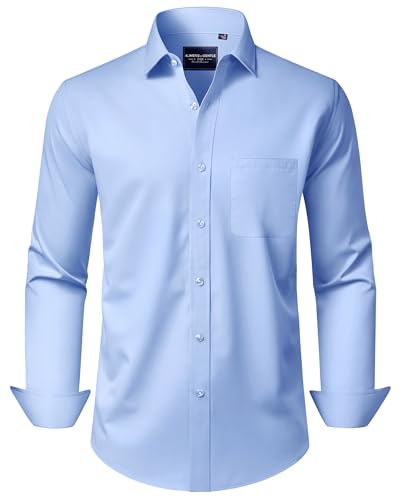
Spread Collar Shirts: The Complete Style & Buying Guide
"The collar that frames your face, flatters your tie, and works from the boardroom to the reception."
The spread collar is arguably the most versatile collar style in a man's wardrobe. It is the collar you reach for when you need to look polished at a wedding, sharp in a meeting, and relaxed at a dinner afterward—often without changing your shirt. Yet many shoppers treat collars as an afterthought, focusing on fit and fabric while ignoring the single detail that frames the face in every photo and conversation.
This guide breaks down exactly what makes a spread collar different, who it flatters, which ties and knots complement it, and how to judge quality when you are comparing options online. By the end, you will know precisely what to look for before you commit to a purchase.
What Exactly Is a Spread Collar?
A spread collar is a dress shirt collar where the two points are angled outward at a wider angle than a traditional point collar. Instead of the points sitting close together near the throat, they spread apart, creating a broader, more open V-shape across the chest. This wider opening is the defining feature, and it is what gives the collar its slightly more modern, confident appearance.
The category is actually a spectrum. At the conservative end sits the semi-spread collar, which widens only modestly and remains appropriate for almost any setting. In the middle is the standard spread collar, the most common version you will find in ready-to-wear shirts. At the dramatic end is the cutaway or extreme spread collar, where the points angle sharply outward and can sit nearly horizontal. For most men, the semi-spread and standard spread are the practical choices, while the cutaway is best reserved for formal occasions and confident dressers.
The quick test: Lay the shirt flat and look at the angle formed between the two collar points. If the points are close together and nearly parallel, it is a point collar. If they form a clear outward V, you are looking at a spread collar. The wider the V, the more "spread" the collar.
Spread vs. Point vs. Cutaway
Understanding how the spread collar compares to its neighbours makes the buying decision much easier. Each style solves a different problem.
- Point collar: The traditional, narrow-angle collar. It frames the face tightly and works with slim ties and small knots. It is conservative and timeless, but can look slightly dated in very formal settings and can appear to pinch the face.
- Spread collar: The versatile middle ground. The wider angle opens up the chest, balances fuller faces, accommodates larger tie knots, and holds its shape well when worn open. This is the most adaptable collar for a modern wardrobe.
- Cutaway collar: The boldest option. The points angle sharply outward, sometimes almost horizontally. It is striking in photographs and pairs beautifully with a full Windsor knot, but it demands confidence and suits formal or fashion-forward contexts better than everyday office wear.
If you are building a small capsule of dress shirts, a semi-spread or standard spread collar should be your default. It covers more situations than any other single collar style, which is why it has become the standard for modern business and formal dress.
Matching the Collar to Your Face Shape
Collars are frames, and like any frame, they interact with what sits inside them. The right spread can balance your features; the wrong one can exaggerate them.
- Round face: A spread or cutaway collar is an excellent choice. The horizontal width of the collar adds structure and length, balancing the softness of a round face.
- Oval face: Most collars suit an oval face. A standard spread is a safe, flattering default, while a semi-spread keeps things understated.
- Heart-shaped face: A spread collar works well here too, as the wider angle balances a broader forehead and narrower chin.
- Long or narrow face: Be cautious with extreme cutaways, which can make the face appear even longer. A semi-spread or a moderate spread is usually the safer, more balanced choice.
- Square face: A spread collar softens strong jawlines slightly, while a point collar can emphasize angularity. Both work, but the spread is generally more forgiving.
The takeaway is simple: the wider and rounder your face, the more a spread collar flatters you. The longer and narrower your face, the more you should lean toward a moderate semi-spread rather than an extreme cutaway.
Choosing the Right Tie Knot
The spread collar's wider opening creates space at the throat, and that space needs to be filled with an appropriately sized knot. This is the single most common styling mistake men make with spread collars—pairing them with a tiny knot that leaves an awkward gap.
- Full Windsor: The classic partner for a spread or cutaway collar. Its wide, symmetrical triangle fills the collar opening perfectly and looks formal and deliberate.
- Half Windsor: A slightly smaller but still substantial knot that works beautifully with a standard spread collar. It is the most versatile pairing for everyday and semi-formal wear.
- Pratt (Shelby) knot: A medium-sized knot that suits semi-spread collars well. It is a good middle ground if a full Windsor feels too bulky.
- Four-in-hand: A slim, slightly asymmetrical knot. It is best reserved for point or very narrow semi-spread collars. In a wide spread collar it can look undersized and leave visible gaps.
Styling tip: If you love a slim tie, choose a semi-spread collar rather than a full spread or cutaway. The narrower collar opening matches the narrower knot, keeping the proportions balanced.
Wearing a Spread Collar Without a Tie
One of the strongest arguments for the spread collar is how well it performs when you take the tie off. Because the points hold their angle and structure, the collar frames the face neatly even when open at the top button. A point collar, by contrast, can look a little collapsed or floppy in the same situation.
For smart-casual outfits—an open spread collar under a blazer, a knit sweater, or a tailored jacket—the semi-spread version is especially effective. It looks intentional rather than undone, which is exactly what you want when the dress code is "smart casual" or you are transitioning from a daytime ceremony to an evening reception. If you are attending a wedding and want a shirt that works for both the ceremony and the after-party, a spread collar is one of the most practical choices you can make.
Where Spread Collars Fit: Weddings & Formal Events
In the context of formal events, the spread collar is a natural match for many dress codes. It works with a suit and tie for semi-formal and formal weddings, pairs well with a tuxedo-style look when you want a slightly more contemporary edge, and holds up beautifully in photographs because its structure stays crisp all day.
For grooms and groomsmen, the decision often comes down to suit versus tuxedo and, within that, collar style. A spread collar shirt sits comfortably within both worlds, which is why it is frequently recommended for modern wedding attire. If you are considering formal menswear more broadly, our guide to suit vs. tuxedo explains how collar choice interacts with the overall formality of your outfit. And if you are coordinating a wedding party, our notes on groomsmen attire etiquette cover how to keep everyone consistent without looking identical.
Beyond the ceremony, a spread collar shirt is equally at home at the rehearsal dinner, a formal engagement party, or a black-tie-optional event where you want to look sharp without overcommitting to a tuxedo. If the dress code is black tie optional, a well-fitted spread collar shirt with a suit and a half Windsor is a reliable, polished choice.
Wedding-day note: If you are the groom or in the wedding party, choose a shirt with a firm, structured collar (sometimes called a fused or semi-fused collar). Soft, unstructured collars can wilt under a tie and lose their shape during a long day of photos and dancing.
What Separates Entry-Level from Premium
Collar style is only half the story. The other half is construction quality, and this is where careful shoppers separate themselves from impulse buyers. When comparing spread collar shirts online, look at these factors:
- Collar interlining: Entry-level shirts often use a thin or soft interlining, which means the collar loses its shape after a few washes. Mid-range and premium shirts use a firmer interlining or a semi-fused construction that holds the collar's angle over time.
- Collar point length and tie space: Well-made spread collars have carefully proportioned points and a defined "tie space" (the gap between the collar points above the button). Cheap versions often have uneven points or a collapsed tie space.
- Stitching and seam finish: Look for clean, even stitching along the collar edge and a tidy finish where the collar attaches to the shirt. Premium shirts often use a higher stitch density and a more refined finish.
- Fabric quality: Entry-level shirts may use thinner, rougher cotton blends that wrinkle quickly. Mid-range and premium shirts typically use two-ply cotton with a smoother hand, better drape, and more durable colour.
- Removable collar stays: A small but telling detail. Shirts with removable stays (and a pocket for them) are generally a step above those with stitched-in plastic stays.
As a general rule, an entry-level spread collar shirt will look fine on day one but may soften and lose its crisp angle within a season. A mid-range shirt typically offers noticeably better collar structure and fabric, while premium and luxury shirts focus on finer cotton, cleaner finishing, and more precise proportions. If you wear dress shirts regularly, the mid-range tier is usually the sweet spot for durability and appearance.